Hockey

Source: Hockey Australia

MODERN TIMES

  • Australian hockey players have three salary streams: 
    • Hockey Australia payments, 
    • Australian Sports Commission payments, 
    • Australian Olympic Committee medal incentive payments.
    • Many leading players play professionally in European and Indian Leagues
  • The salaries are small, however. 
  • It is said playing hockey for Australia is a full-time job without a full-time salary.
  • Importantly however, Hockey Australia has prioritised equality in funding and conditions for both the women’s and men’s national team players.
  • Annual incomes range from approximately $40,000 to $65,000.
Source: Hockey Australia

RECORDS. MILESTONES. MOMENTS.

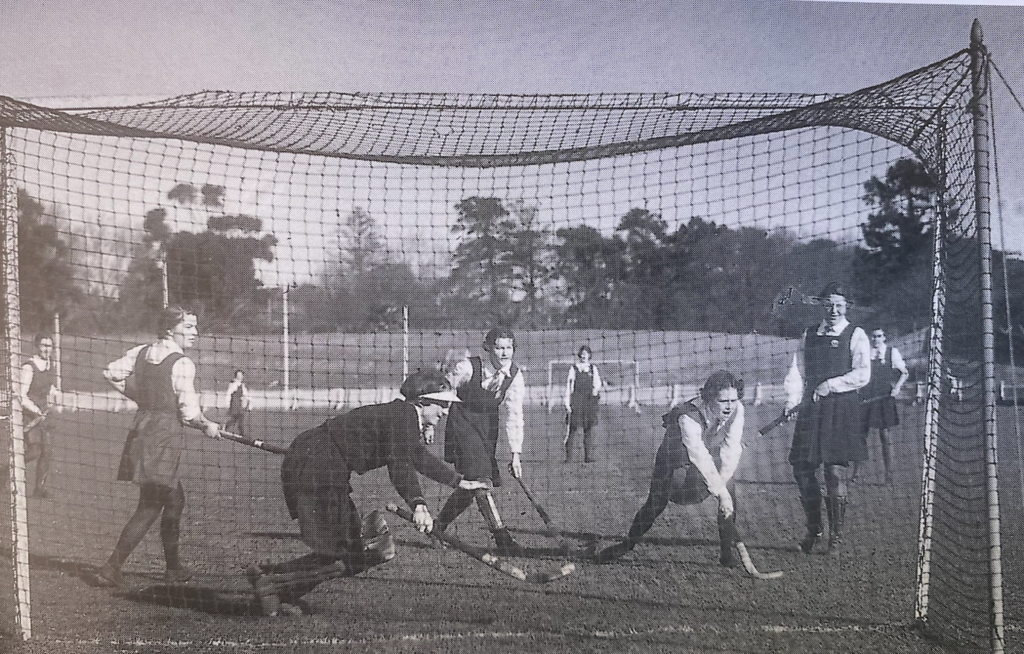
Playing in full skirts (six inches off the ground), caps and heavy, high-laced-up boots, the first Interstate championships were held in 1910 in Sydney. SA finished third.

Three sisters from the Waterhouse family had learned to play hockey in England in the late 1800s and loved the game so much that they wanted to introduce it to their schoolfriends in Adelaide.

Creating what is known as the Golden Era for Australian women’s hockey, the Hockeyrooos won back to back Olympic Games gold medals in 1996 and 2000.
HISTORICAL TIMELINE

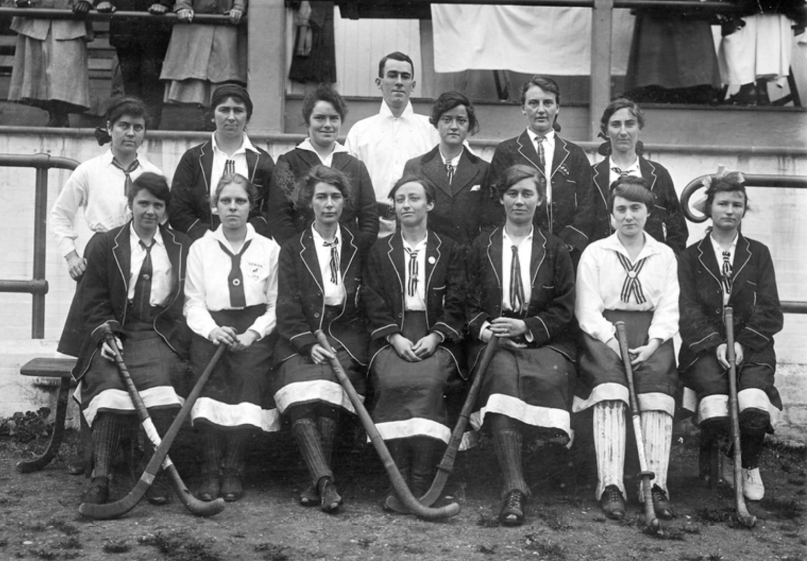
SA women’s hockey team 1918 Source: - State Library of SA (PRG 280/1/15/39)

1900's

  • In early times five rule requirements applied to the hockey stick:
    1. The stick had to be flat on the playing side and had to be able to be passed completely through a two-inch (internal diameter) ring.
    2. The stick was to be smooth (no rough or sharp edges).
    3. The head of the stick was to be a) curved and 
    4. b) made from wood and maximum and minimum weights were specified.
  • Ballarat’s Loreto Abbey Mary’s Mount students played the first recorded hockey game play in 1896.
  • Schoolgirls began learning the game in Adelaide in 1900.
  • South Australia was first state to establish hockey as a game for women and to form an association – the South Australian Ladies Hockey Association (SALHA) – 1905. It was 1908 before NSW formed its state association.
  • The United Ladies’ Hockey Association (ULHA) was also formed in 1905 with six teams, as the SALHA restricted its membership to 11 teams. The rivalry between the SALHA and ULHA was healthy, and they played inter-association games in 1905, 1906 and 1907. The 1905 and 1906 games were played at the Adelaide oval. Norwood Oval hosted the 1907 game.
  • There is no mention of the UHLA beyond 1907.
  • Some rules were quite basic: Each player must carry a stick and cannot take part in the game without it. 
  • Women played in uniforms similar to their regular clothes – long skirts 6” from the ground, high collars and large hats fastened with long hat pins.

1910's

  • The game spread quickly and by 1910, hockey had become popular in country towns including Burra, Riverton and Jamestown.
  • On 2 July 2010, the AAWHA became Australia’s first national women’s sport organisation. By now, the term “Ladies” had been replaced by “Women”.
  • A leather white cricket ball was used as the hockey ball. 
  • Games were played in the South Parklands and cow pats were picked up from the field before games.
  • Playing in full skirts (six inches off the ground), caps and heavy, high-laced-up boots, the first Interstate championships were held in 1910 in Sydney. SA finished third. 
  • In 1914, the All-Australian Women’s Hockey Association invited England to play practice matches in SA on their way to NZ. The other states also participated, and the first Australian team was selected.
  • In another first for hockey, the 1914 international match was the first international game for any women’s sport in Australia.
  • Five South Australians were chosen in that team – including captain Judy Smith (Mackay) who played full-back and is now a SA Hockey life member – and Elsie Babbage, Joan Cleland, Annette Sands, and Bertha Delaine. England thrashed Australia 11-3.

1920's

  • Tunics were modernised and shortened to be less restrictive. Sandshoes replaced high boots. However, long sleeved blouses and stockings remained.
  • The AAWHA affiliated with the International Federation of Women’s Hockey Associations and international tours became a focus. 
  • The States agreed to bear the touring costs of England in 1927, SA having to raise 148 Pounds or $12,000 (2020 terms).
  • 1923 SA are national title holders without losing a match.
  • 1927 Australia with three SA players – Edna Davidson and Freda Gault and Lyndall Morris – plays two Test matches against England. Australia loses 2-8 and 0-11. 
  • Lyndall Morris had also been selected for Australia in 1925, 1933-36 and 1938. She also chaired the SAWHA in 1925, 1927-28, 1934, 1938 and 1946-47.
  • Lorna Jolly commences what would be a 50-year career playing, captaining, managing and supporting hockey in SA, ultimately retiring from her service in 1969. She was awarded an OAM in 1982.

1930's

  • Hockey was considered a middle-and upper-class sport, given most of its players learned the game in private girls’ schools and only those who could afford the costs to travel were selected for overseas tours.
  •  A nine-month tour to South Africa, England and Europe by the first ever touring Australian team took place (1930). Australia lost its three matches against England and Scotland and two out of three to South Africa.
  • The Great Depression impacted much of life including a reduction of sporting clubs including hockey.
  • Evelyn Tazewell also represented Australia, this time as vice-captain, in 1935 against NZ and in 1936 to the US for the IFWHA tournament for the first time. She was selected as goalkeeper. Mabel Cashmore and Jean Mackay were also in this touring team to the US.
  • They sailed aboard the RSS Niagara on which the captain made the captain’s deck available to the players for “exercises at 7.15am and stick work at 10am”.
  • Team rules were the following: “No smoking, no drinking, no gambling, in bed by 10.30, no late hours and do everything you are told.”
SA v Victoria Interstate game 1935 - Source: Hat Pins to Body Suits (Kath Taintey)
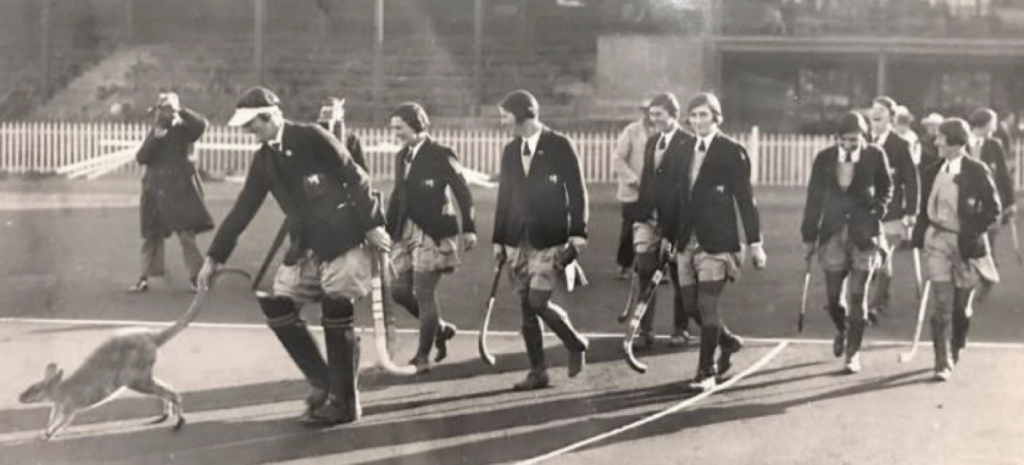
Evelyn Tazewell leading Australia out (with Australia’s Living Mascot) before a game in Johannesburg 1930 - Source: Trove National Library.

1940's

  • The 1939 Australian team was due to leave for England for the IFWHA Tournament when WW2 broke out and everything was cancelled.
  • The decade of the 1940s was dominated by the war – but despite the reduced numbers of clubs, players and umpires – the state league continued in South Australia.
  • Interstate competitions re-started in 1945.
  • In 1948 Mary Teesdale-Smith was SA’s only representative in the Australian team that toured NZ. Players met their own expenses for this trip – a sum of 70 pounds.
  • A combined Hockey Ball with the men’s association was held at The Palais Royal. In a huge turnout, 1271 people attended, raising 77 pounds 5 shillings and 7 pence. 
  • In a significant event, Lois Quarrell resigned from The Advertiser after 13 years as special women’s sportswriter. During her term, she had also held office as President, Vice President or Secretary with many organisations including the SA Women’s Hockey Association.
  • The box-pleat tunic had arrived, but society’s restrictions still dictated that bloomers should be worn and pulled down below the knees.
  • In 1946, the state executive meeting requested the following of the state team .. “It was decided to ask the team to refrain from so much smoking and perhaps other excesses during the tour …”

1950's

  • By now women were playing in knee-length tunics with collared white short-sleeved shirts, and short socks replaced stockings.
  • Women were achieving greater social and financial freedom and independence and in sport, specific fitness programs began to be introduced.
  • Country associations were flourishing, and multiple young women staked a claim in SA State teams including the first woman to do so, Joy Dalton from Whyalla. 
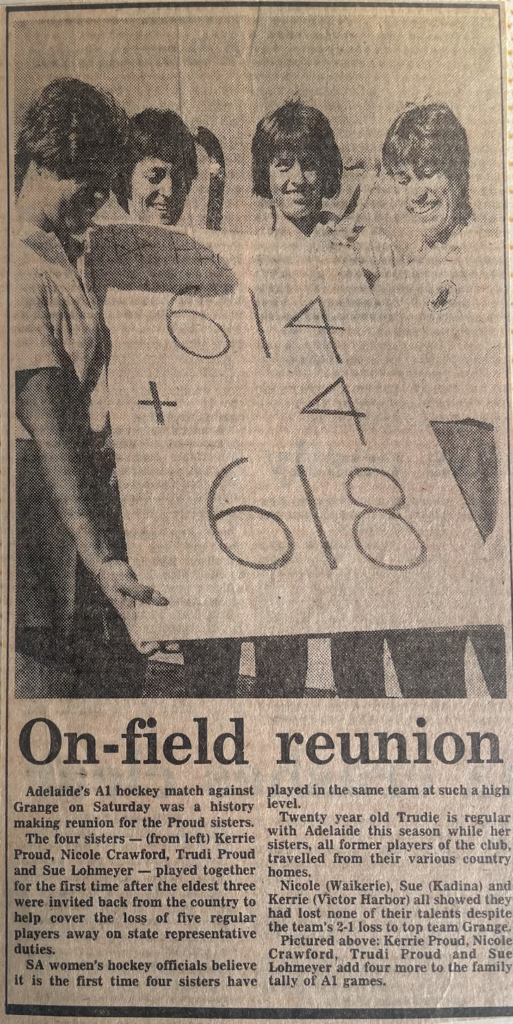
  • Over the following years, four Proud sisters of Loxton in the Riverland achieved the distinction of all representing SA. 
  • It was in 1953 at the fifth IFWHA tournament in England that Australia showed it had come of age as a world force in women’s hockey. Patricia Haigh, Pam Gregory, and goalkeeper Margaret Wallage were SA’s reps.
  • History was made when Australia finally beat England for the first time 2-1. 
  • Australia hosting the 1956 Olympic Games, gave greater visibility to female athletes.
  • Men’s hockey had been permanently included in the Olympic Games since 1928, but the IOC had rejected two women’s submissions in the 1930s and 1940s. 
  • The State teams travelled by bus to All-Australian tournaments – and in 1954 took three nights and four days to get to Brisbane. 
  • In 1959, on their way to Sydney, the players were required by the coach to alight from the bus and run along the bitumen road to their nightly stop-over town. Many incurred shin splints
Margaret Wallage - Source: Hat Pins to Body Suits (Marjorie Whincup)

1960's

  • Women had more than selection challenges in being chosen for international tournaments. In applying for Australian passports up to the 1970s, married women needed their husbands to sign their passport applications. 
  • Furthermore, the AAWHA also required the players’ husbands to sign a “release form” to enable their wives to travel overseas.
  • For single women, it was the father who would sign the same documents, such was the patriarchal culture of the period.
  • Australia sent teams away to Asia, Europe and North America during the 1960s. Selection was still generally open to those who could afford the costs – or who could take considerable time away from work or home duties.
  • Finally, SA women were developing greater skills since playing on quality surfaces thanks to the development of the Women’s Memorial Playing Fields from the mid 1950s onwards.
  • A hockey pavilion with large changerooms, toilets, hot showers and canteen was built on the South Parklands and named the Evelyn Tazewell Pavilion.
  • In 1965, the Australian team was captained by a South Australian – Helen Dew.
  • Jeannette Freebairn as fullback, Helen Dew a forward, Barbara Haigh as halfback, Jill Bourman as fullback, and Eileen Pritchard as forward, were all named to Australian teams throughout the 1960s.
  • Large-scale schoolgirl clinics were organised by a committed and industrious volunteer Val Nairn in which state players coached small groups. Nairn had written to 52 schools inviting them to send players.

1970's

  • Many new clubs were entering the competition through this decade: old scholars’ teams, combined teachers’ college teams, and high school teams.
  • The most influential sign of progress came with the introduction of junior grades. Other sports such as basketball and netball were already running competitions for primary and high schools plus U18, U16 and U14 grades.
  • By 1979, the association had 1515 registered senior players and 406 juniors, about half of whom were players from regional associations.
  • Men’s and Women’s Clubs began to amalgamate. Brighton won five premierships from 1970 to 1981. 
  • At the end of the decade, the long-awaited amalgamation of the men’s and women’s associations took place, sparking discussions about the development of a central hockey stadium.
  • Many of the grounds were still inappropriate for high level hockey – with concrete cricket pitches marring the centre of the field, having to be covered with sand for hockey during the winter.
  • In 1975, the Interstate Tournament became the Australian Women’s Hockey Championships and in 1975, SA state colours became navy, red and gold.
  • Women who represented Australia through the 1970s decade from SA were Marg Jude, Judy Blight, Wendy Dalton, Pamela Jackson, Mary Burston, Jill Mann, and Sandra Mortimer.
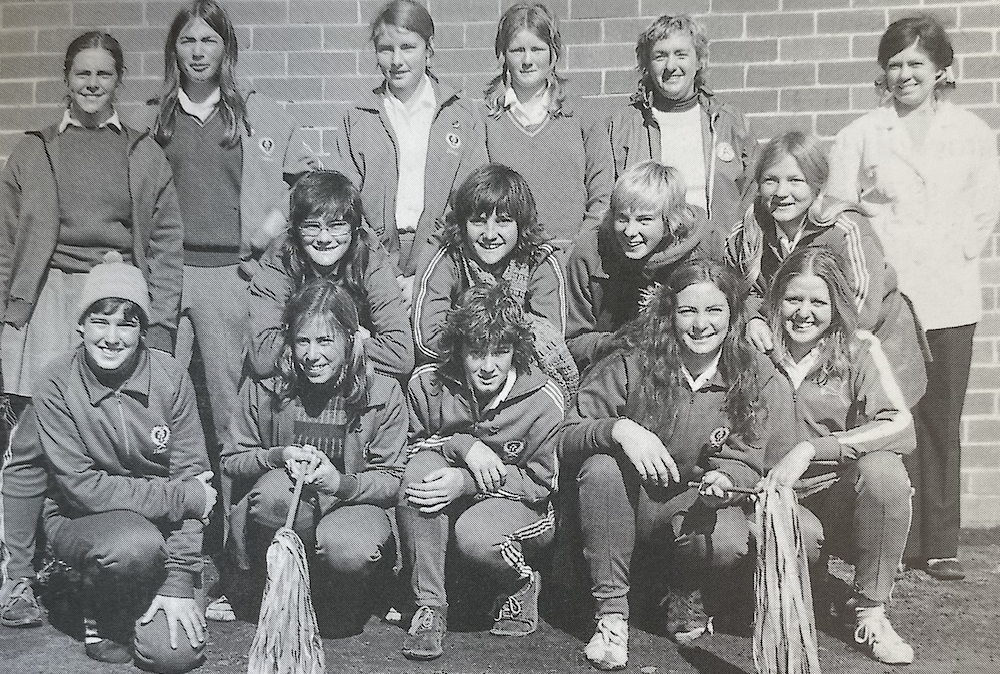
Source: Sue Lohmeyer and Hat Pins to Bodysuits

Back: Jane Bell, Jenny Jacobs, Jane Lamprey, Debbie Cahill, Margaret McKenzie (coach) Bev Egan (manager)

Middle: Sally Nobbs, Sue Jones, Chris Haskard, Carol Sinclair.

Front: Anthea Bond, Sue Proud (V/C), Prue Somerville, Sandra Raftry (C), Marion Anderson.  
1980's

  • Without a doubt the 1980s was the most significant decade for hockey in SA. Women’s hockey was finally included in the Olympic Games.
  • It was also the decade in which the $4.7m State Hockey Stadium was built – with a pitch that was of Australian and world standard.
  • The artificial turf was a fast and even surface, directly influencing a considerable change to the standard and strategy of the game.
  • Architect Patrick Pak Poy chaired the organising and designing committee and is honoured by the Pak Poy VIP Room at the Pines.
  • In 1981 Aroha Club donated a perpetual shield called the Aroha Shield for the A grade women’s premier. Amazingly, Aroha had only been absent from one A-grade grand final since 1948.
  • Mobil Oil emerges as the nation’s first sponsor of an amateur sports team, supporting the SA state team.
  • After the 1981 nationals, Sue Watkins and Sandy Pisani were selected to the Australian team for the World Cup in Argentina.  Australia 4th. 
  • Hockey was admitted to the SA Sports Institute program with scholarships worth $13,000 awarded to Sue Watkins, Sandy Pisani, Kerri Proud, Tiffany Bell and Jill Cassidy.
  • Lifelong service by Port Pirie’s Evelyn Tavener saw her awarded not just Life Membership of the SAWHA, the only country member at the time to receive such an honour, but also an OAM for services to sport. She was a major factor in growing the sport in the Port Pirie region and beyond. It’s reported that her headstone proudly includes a hockey stick and ball.
  • In a brutal 1983 World Cup in Kuala Lumpur in which players played in 46-degree heat and 95 percent humidity, Sandy Pisani and Sue Watkins helped Australia to a bronze medal.
  • Australia was seeded No. 2 for the 1984 Olympics and with SA’s Pisani and Watkins, finished fourth. Sue Watkins, having played for Australia 39 times, retired after the Olympics.
  • SA’s team manager Yvonne Parsons is selected as manager of the Australian team.
  • Woodville club builds its own sand-filled synthetic grass surface. Port Adelaide followed suit.
  • Australia wins gold at the 1988 Olympics, with Sandy Pisani our only representative and Yvone Parsons the manager. It is the first Australian team of any sport in history to win an Olympic gold medal.
  • Tricia Heberle was appointed as head coach of the Intensive Training Centre in SA.

1990's

  • In a startling announcement, it was claimed the artificial turf at The Pines Stadium needed to be torn up after being assessed by the International Hockey Federation as unsuitable for international competition.
  • The artificial grass had been laid incorrectly, producing an uneven and irregular bounce, but the manufacturer had gone into receivership so ultimately the association and State government went halves in the cost of its replacement.
  • Diet Coke stepped in as the major sponsor of SA Hockey.
  • At the close of the national championships in 1991, an Australian squad of 19 was announced to play South Korea. The squad included two South Aussies, Juliet Haslam and Alison Peek.
  • Australia wins its first Champions Trophy in Berlin.
  • Jill Smith wins her third association best and fairest and retires in 1992 after captaining Grange to its state league title and representing SA 11 times, three as captain.
  • A national league is proposed by Hockey Australia, but SA is unable to afford to participate in the first year but do so as the Diet Coke Suns in 1993.
  • Juliet Haslam and Alison Peek are selected for the 92 Olympics. Justine Sowry is added to the 1993 team.
  • Port Inlanders win their first every state league final. It was the beginning of a rich period of success for the club.
  • In 1994, four South Australians take part in the World Cup winning Hockeyroos.
  • Kate Sage and Cat Brook also played for Australia in various tournaments through the 90s.
  • 1995 Trisha Heberle assembled what would be a history-making Suns squad for the third Telecom Stix Series. Gwen Burt was included in her 13th year as State manager.
  • The Suns win the title, defeating NSW at the Pines 3-2 to end one of the longest droughts in SA sporting history.
  • With four South Australians in the 96 Olympic squad, it was a shock that Juliet Haslam was the only player from SA eventually selected. The Hockeyroos win gold, defeating South Korea 3-1. 
  • Doug Nairn becomes the first SA coach to receive a government sponsorship to study for a Level 3 Coaching Accreditation and Graduate Diploma in Sports Coaching.
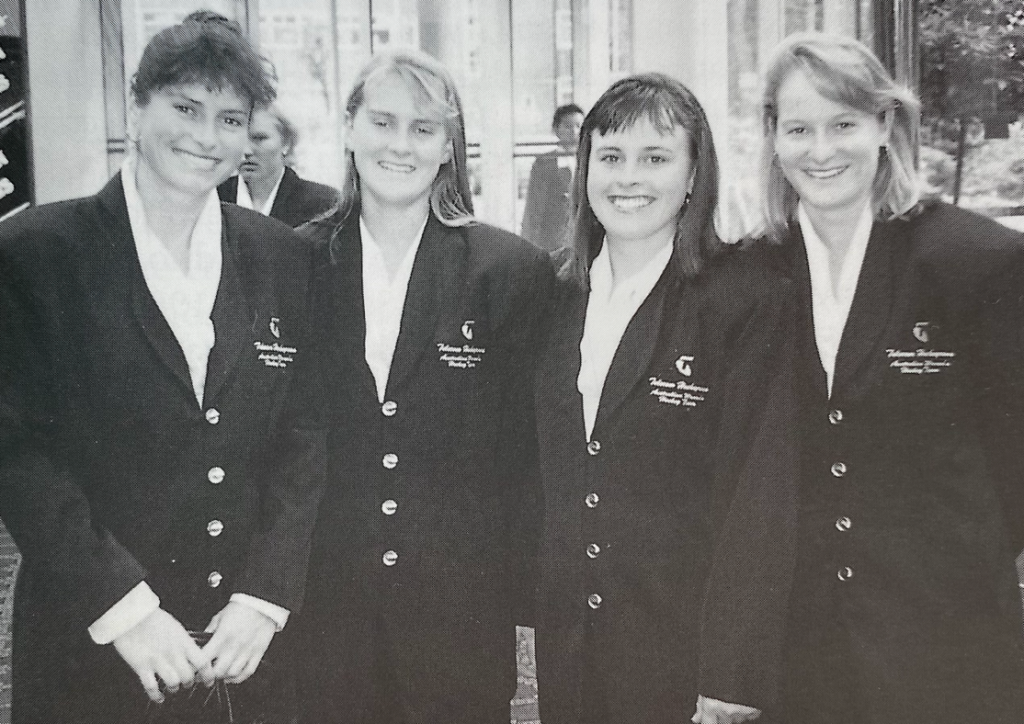
Juliet Haslam (v/c), Katie Allen, Justine Sowry, Alison Peek - Source: Hat Pins to Bodysuits (Marlene Haslam)
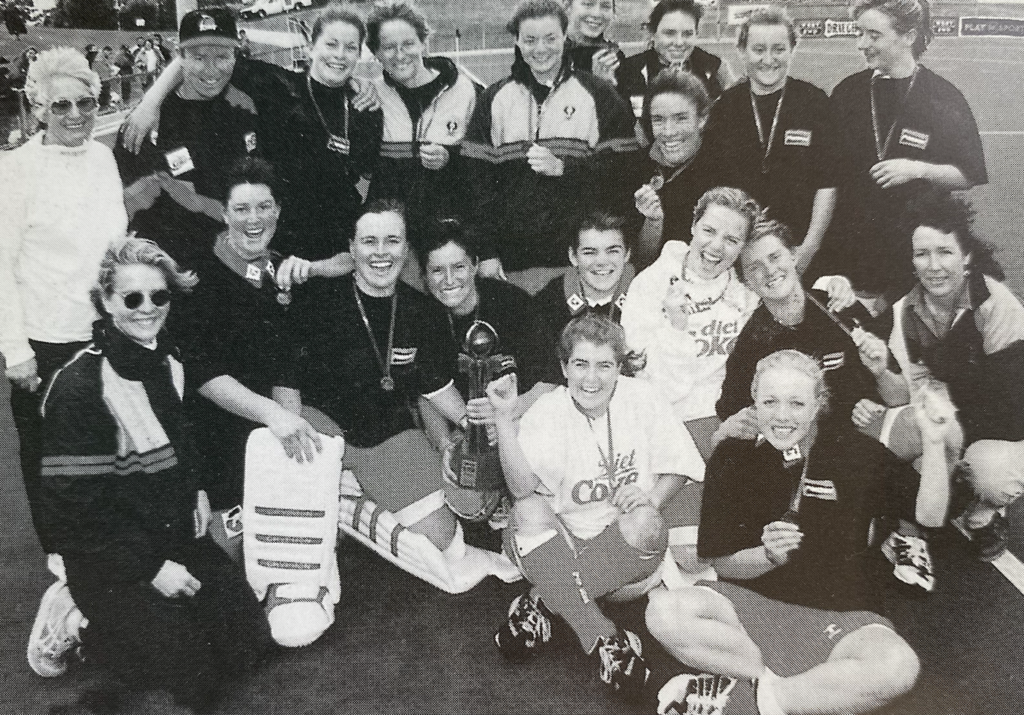
The 1995 History-Making Suns - Source: Hat Pins to Body Suits (Hockey SA)

2000's

  • The decade began promisingly with three South Australians – Juliet Haslam, Alison Peek and Katie Allen – winning an Olympic Games gold medal at the Sydney Olympics in 2000. 
  • The SA Under 21 team also won the national title in 2001.
  • The Hockey One League’s SA team Adelaide Fire performed well contributing players to the national team – including Carmel Souter (Bakourski) 1998-2004; De-Anne Gilbert 2005-2009; Holly Evans 2010-2012.
  • Carmel Bakourski from Murray Bridge and Katie Allen from Adelaide were named to the Hockeyroos 2004 Olympic team. Australia finishes 5th.
  • Donna Lee Patrick was the only South Australian in the 2006 Champions Trophy team.
  • The Champions Trophy squad includes newcomer Georgie Parker. Parker was added to the official Hockeyroos national squad after outstanding performances for the Southern Suns at the Australian Hockey League.

2010's

  • Country regions: Hockey in country regions from the sport’s introduction in the early 1900s and Hockey SA has continued to help the game flourish there.
  • For example: By 1979, the association had 1515 registered senior players and 406 juniors. About half of these numbers were players from regional associations.
  • Among the players who have played for Australia but were born and raised in country SA are:
    • Carmel Souter Bakurski – Murray Bridge 
    • Justine Sowry – Whyalla
    • Georgie Parker – Berri
    • Karri McMahon – Berri
    • Lucy Sharman – Penola 
    • Kerrie Proud – Loxton
  • Kerrie Proud was one of the four Proud sisters all of whom remarkably played hockey for SA. They are in order of age: Nikki Proud, Sue Proud (Lohmeyer,) Kerri Proud, and Trudie Proud.
  • Born and raised on a farm 10kms out of Loxton in the Riverland, the four are a further example of the strength of SA country hockey. 
  • Their Mum Deb Proud introduced her daughters to hockey and each of them ultimately moved to the city and joined the Adelaide Hockey Club. 
  • Given the 12-year age gap between oldest and youngest, the Prouds only played together in club hockey on one occasion (see below), but three managed to play in the same State team at the national championships in Perth in 1983.
  • Elsewhere synthetic surfaces have been laid on the majority of club’s grounds including Forestville, Adelaide University, Adelaide, Woodville, Port Adelaide, North East and Seacliff.
  • Only Burnside and Grange have been unsuccessful in getting approval from their local governments.
  • During the decade 2010 to 2020 and beyond, SA contributed seven players to the national team for various tours, tournaments and championships: 
    • Holly Evans 2010-2012, 
    • Elise Stacy 2011, 
    • Joyce Greenshields 2011-2013, 
    • Karri McMahon 2012-2020, 
    • Georgina Parker 2012-2016, 
    • Jane Claxton 2013-2024, 
    • Michaela Spano 2019, 
    • Harriet Shand 2022-2024.
They continue to give back to the game through coaching, playing, administrating and supporting. - Source: Sue Lohmeyer

2020's

  • Jane Claxton was the only South Australian player to be included in the extraordinary Tokyo Olympic Games which were disrupted by the world-wide Covid epidemic. All sports took place without an audience. Australia lost 0-1 to India in the quarter finals. 
  • SA’s Katie Allen was the assistant coach. 
  • Jane Claxton was selected to the Paris Olympic team as co-captain 2024. Hattie Shand from Naracoorte in the South East was named as a travelling reserve.
  • Masters: One of the features of SA Hockey remains the strong retention of past players who not only play in SA Masters teams and the Australian Masters Games, but also coach junior development teams, and step into administrative positions in their local clubs.
  • This lifelong involvement is an essential component of hockey competition in SA, and it is commonly found that parents and their children are all playing at the same club and some in the same team.
  • It would seem the game lends itself to long-term playing, given that there is less strain on joints than its rival sports of netball and basketball. 
  • But there is also a strong sense of camaraderie that keeps people and teams together over the decades. Following a Saturday division six game, for example, the veterans’ team will gather for drinks and nibbles afterwards to revel in each other’s company and in the joy of still playing the game.
  • While it varies from year-to-year SA usually produces four teams for the Australian Masters Games which hosts competitions for over 35s and upwards.  The only Masters team to win a national championship is SA’s Over 45s.
  • It’s been observed anecdotally that the general athleticism and musculature of the players have been preserved very well over the decades.
  • Australia was knocked out of the 2024 Paris Olympic quarter finals by China in a close 2-3 result.

Bibliography:

STORIES OF OUR PIONEERS

Meet the trailblazers of SA Hockey. 

Airelie Keen

Airlie Keen was appointed to the FIFA Assistant Referees Panel each year from 2001 to...

Alison Peek

Alison Peek’s open, fun-loving, welcoming ways clearly belie an unfaltering, unrelenting attitude on the field....

Ann Gibbons

Ann Gibbons was one of only two female inductees into the Football SA Hall of...

Anna McVann

Selected for the XXIII Olympics in Los Angeles at the age of just 15, Anna...

Anna Pazera

Rather than return to Communist Poland, Anna Bocson (Pazera) stayed in Australia after competing in...

Anne Hatchard

The 175cm mid-fielder highlighted her dominance by winning the Adelaide Football Club’s best and fairest...

Anne Shanley (Cooper)

In 1950, Anne Shanley was SA’s first female National Champion, the first female National record...

Anne-Marie Knight

In 2016 Anne-Marie Knight was the first female in South Australian PGA history to be...

Annie Fidge

Annie Fidge is part of a family softball dynasty. Her mother, Julie Dale, is a...

Barb Mattson

Barb Mattson captained her club team Brighton to State League premierships, the SA state team...

Barbara Bawden

Barbara Moffatt’s height gave her additional reach, which together with her flexibility were significant assets...

Barbara Phillips

A 1950 media report said: “Barbara Phillips (pitcher) proved … that she can not only...

Bec Goddard

After more than a decade of junior involvement in footy as a player then goal...

Belinda White

In her international retirement speech, “after 13 years - 4 world championships, 2 qualifiers, 1...

Bobby Milburn

Bobby Milburn

A skilful medium-pace bowler, Bobby Milburn played for Australia for over a decade in the...

Brenda Pearl

Brenda Pearl became the first woman in the southern hemisphere to be selected on a...

Brooke Kruger-Billett

As neither SA nor Australia had a strong tradition in throwing the 4kg hammer, in...

Carla Boyd

Carla Boyd was a key player in the Opals team through the 1990s that emerged...