
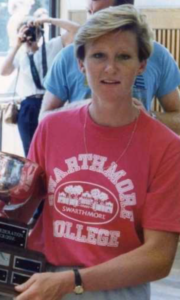
Back home in SA, Mary Pickett was also Captain of the SA State women’s team that dominated the national titles, winning 11 consecutive Australian championships, including two as coach.
It was a Sunday morning back in 1971. Mary Herbert was a 13-year-old student at Seacombe High when she was invited to a ‘Come-and-Try’ lacrosse session on the school oval.
She turned up at the oval and watched for a while.
Teachers from the school and lacrosse enthusiasts, Jean and Barry Bain, had organised the introductory session in the hope of adding greater strength to the Seacombe Club already competing in the State League.
But the game didn’t immediately appeal, and she left. She was already enjoying basketball and this new game looked strange and too difficult to master.
It was not to be left there. Senior club players could see the parallel between Mary Herbert’s skills on a basketball court and those of lacrosse, so they pursued her further.
The lack of interest was soon to be reversed. She spent hours with Jean Bain at school refining stick skills and throwing the ball against the brick chimney at home.
In 1974, two years later, she was named in the U16 State team. In 1975, she captained the Under 16 State Team, was selected in her first Senior State Team and played in her first A Grade grand final victory for Seacombe, the first of what was a remarkable seven consecutive premierships.
Mary Herbert, now Pickett, became known across the world for her skilled brilliance.
A dynamic midfielder and attacker, who was described as having ‘a lethal but controlled overhead check and under arm shot’ was the target of defensive strategies to contain her influence.
Her first Australian selection came as an 18-year-old for the 1978 USA Tour.
She easily transferred the sliding and helping defensive principle from basketball to lacrosse and reveled in the free-flowing style of SA coach, Peter Koshnitsky.
Her international career spanned 10 years from 1977 to 1986. To represent Australia with such durability is exceptional, but to be captain of Australia points to personal qualities such as a pursuit of excellence, strong leadership and a clarity of thought under pressure.
Mary Pickett was elected captain from 1981-1986. It was in her final leadership year that she commandeered the Australians to the top of the mountain defeating the US in the final of the Women’s World Cup.
It brought a measure of satisfaction after the heartbreaking loss in overtime four years earlier.
At the 1982 World Cup, Mary Pickett’s renown was highlighted, being named to the All-World Team and was then selected as captain of the All-World Team.
For reasons unknown, organisers did not name an All-World Team in 1986.
Back home in SA, Mary Pickett was also Captain of the SA State women’s team that dominated the national titles, winning 11 consecutive Australian championships, including two as coach.
Not one to walk away from the sport after retiring, she coached the Brighton Women’s State League team to premierships, (4) the SA State U16, U19 and U21 teams to national titles and served on administrative boards at all levels.
Mary Pickett has been inducted into the Lacrosse Australia Hall of Fame.