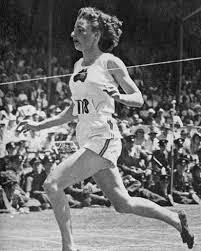
Marjorie Jackson Nelson. - Source: Athletics Australia
On her return from the 1952 Olympics, the Qantas plane diverted its course to fly over her hometown, Lithgow.
Did You Know
Marjorie Jackson Nelson set six individual world records in the 100m and 200m throughout her brief but spectacular international career.
Marjorie Jackson Nelson - Source: Commonwealth Games Australia online
“I’m as good as they are until they prove otherwise … I’m as good as they are until they prove otherwise.”
Beset with nerves, and weighed down by the expectation of Australia, over and over, these were the words Marjorie Jackson muttered to herself as she walked from the underground tunnel to the Helsinki Olympic arena.
At just 20, she was heavily burdened by the presumption of 8 million Australians – the entirety of our national population.
Such was her anxiety, she had vomited just before going out to the track. Three years before as a 17-year-old, there had been headlines in every newspaper after she beat more than once the reigning Olympic 100m and 200m gold medalist, Fanny Blankers-Koen, in Australia.
Australia wanted its first lady of sprinting to be its first female Olympic gold medalist.
Walking out in Helsinki, with years of training behind her now, those years of running on a single-laned bitumen track on the outskirts of Lithgow; running in sleet, fog and snow in the headlights of her coach’s car; of being supported and feted by the local community, she wanted to do this for her parents and for the people of Lithgow.
Expectations of the gold medal had heightened after this exceptional teenager broke the world record in the semi-finals, a record that had stood for 17 years.
The gun went off and eight of the fastest women in the world took off. Just 11.5 seconds later, Marjorie Jackson crossed the line first, almost four metres ahead of second place, then the greatest winning margin in the women’s Olympic 100m.
Qantas diverted the plane on the way home to fly Jackson over Lithgow, and upon arriving home, 20,000 people turned out to welcome their hero home.
SA warmly welcomed a year later Marjorie Jackson-Nelson after she married SA Olympic cyclist, Peter Nelson. And SA has been her home since then. Such was the esteem in which she was held, Marjorie Jackson-Nelson was appointed Governor of SA from 2001-2007.
In a brief but spectacular international career, Jackson set six individual world records, four in the 100 and two in the 200, and ran on the Australian 4×100 relay that set a world record in the heats at the 1952 Olympics.