
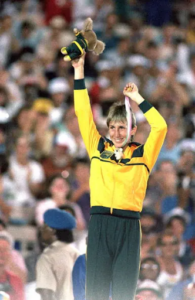
In the final Olympic event, the gruelling 800m, Glynis had to beat her main opponent by 2.5 seconds. She won by 2.46 seconds.
Whenever an athlete bursts across the finishing line in a track event, the winner is almost always known instantly.
But not so for Glynis Nunn at the 1984 Olympic Games. She waited trackside in the majestic Los Angeles Memorial Coliseum with her coach, John Daly, for an agonising 20 minutes.
She had just staggered over the line for the final event of the heptathlon, the 800metres. Over the previous two days, the heptathlon field had faced the rigours of the 100m hurdles, high jump, shot put, long jump, javelin and 200m sprint.
The heptathlon would be completed with two laps. Glynis did not like the 800m … a formidable mental barrier based on crossing the finish line but then having to keep running for another lap.
The great American athlete, Jackie Joyner, led the field by 31 points. Glynis Nunn was second. Coach Daly calculated she would have to win by around 2.5 seconds to take the gold. And – she would probably have to run a personal best to do so.
Every fibre of her being was given to the next two minutes. She beat the American by 2.46 seconds. But it took the officials 20 minutes to be certain of the overall gold medallist, Nunn winning with 6390 points, a margin of just five points.
Almost forgotten at these Olympics is that Nunn also competed in the 100m hurdles and long jump, finishing a very credible fifth and seventh respectively.
Born and raised in Queensland’s Toowoomba, she loved every possible event in athletics. She and her then husband, Chris Nunn, decided to move to SA so he could finish his education as a PE teacher.
It was here that she was coached by John Daly, a senior lecturer in PE at Adelaide Teachers College and head coach of the Australian athletics team. They proved a great partnership.
Glynis was named both Australian Sportswoman and Australian Sportsperson of the Year for 1984. Early the following year, she was awarded the Medal of the order of Australia the New Year’s Honours List.
On retiring, Glynis quickly moved into coaching and administration, filling key roles with the Australian Track and Field Coaches Association and was soon a team coach on national teams, including to the World Junior Championships in Santiago, Chile.
Glynis coached for many years and has served as a national selector and on a range of national committees. She is a Life Member of Athletics Australia and was elected to the IAAF Women’s Committee in 2003.