
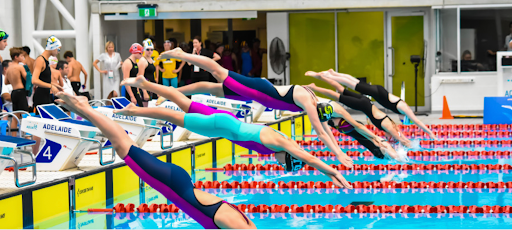
Together with official prizemoney from international meets, plus incentives from the Australian Sports Commission and commercial sponsorships – including from mining magnate Gina Rhinehart – the top female Australian swimmers earn just under half a million dollars a year.
Irrepressible superstar Kaylee McKeown earned $440,000 in 2023, leading into the 2024 Paris Olympics. Ariarne Titmus and Mollie O’Callaghan each earned around $250,000.
Swimming Australia’s contract with its elite swimmers is worth approximately $30,000 each, reviewed every year, and swimmers most often top up that income with sponsorships and by attending events.
While there was no official prizemoney for paralympic swimmers, cash bonuses were given to medal winners at the 2023 World Cup in which 30 medallists shared financial rewards of $455,000.
Denise Norton holds the significant distinction of being SA’s first female to compete at an Olympic Games or Commonwealth Games – the 1952 Helsinki Olympic Games.
The first Swim Through Adelaide was held in 1913, and would become a very popular annual event, with spectators lining both sides of the River Torrens. Officials ran the event from the river boat, Popeye.
Dawn Fraser was the youngest of eight siblings. She moved to Adelaide with coach Harry Gallagher when she was 17 and trained in SA for 6-7 years.
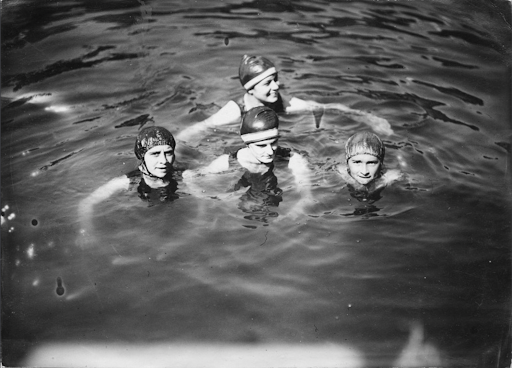
Learn to Swim classes were introduced in many clubs.
SAASA competitions began to attract women. In the 1910 State titles, two heats of four women competed including Flo Hawkes of North Adelaide and K. Farrelly of Glenelg.
In that same year, there were 468 SAASA members, including 54 females.
The first Swim Through Adelaide was held in 1913, and would become an annual and very popular event, with spectators lining both sides of the River Torrens. Officials ran the event from Popeye.
The course took swimmers from the Adelaide Weir to the Albert Bridge – adjacent to the Adelaide Zoo – (1 mile, 200 yards).
Women were included in the event but their prizes for placegetters were far less substantial.
The Henley and Grange Swimming Club, founded in 1912, is the oldest swimming club in SA.
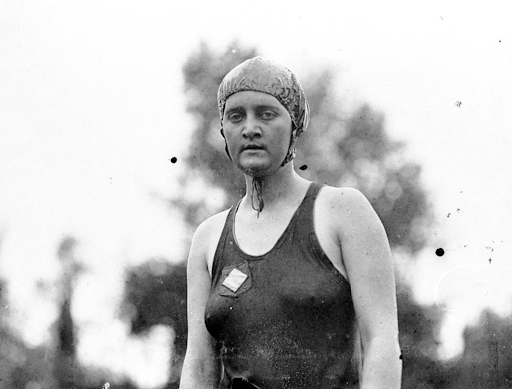
The first Henley to Grange Swim – 1 mile 350 yards – was held in 1917. It was a handicap event where the fastest swimmers started last. No females entered in that year, but several took part in 1918. In 1919 the swim was won by 16-year-old Eileen McKee, who was frowned on as a ‘dare-devil’ as her bathers were sleeveless and six inches above the knee.
The Chairman of SAASA expressed the hope that the victory of Miss McKee would act as a stimulus to other females. Miss McKee was again the winner in 1920.
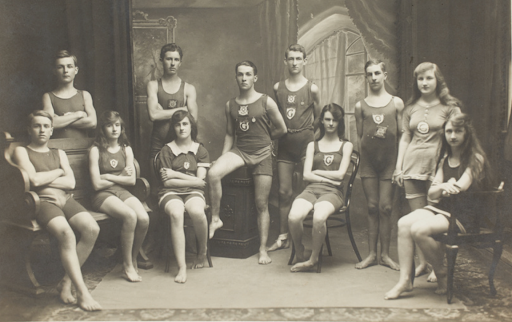
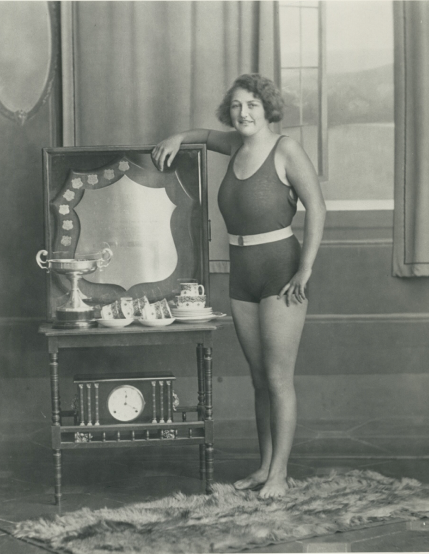
Hilda Harvey (pictured below) at age 16 won the Swim Through the Port in 1930 with a time of 37 minutes and 43 seconds. The following year she set the fastest women’s time in the race.
Amid a proliferation of country pools, the Country Swim Championships were introduced.
By 1963 more than 40 new pools had been constructed, most of them in country regions.
When Harry Gallagher and Dawn Fraser left Adelaide in 1962, a young SA backstroker Marlene Dayman joined them in Melbourne. As a 12-year-old, she had won the SA senior 220 yd backstroke title and was later selected for the 1964 Olympic team.
Adelaide had been awarded the 1962 Commonwealth Games but were then withdrawn because SA lacked a quality, modern Olympic-size pool with proper diving and water polo amenities.
Few professional coaches and a lack of heated pools meant that swimmers could not train all year round and at the 1967 Australian championships, SA finished last.
SA Premier Don Dunstan directed that a new Festival Theatre would be built on the site of the city pool and a new Adelaide Swimming Centre would be built in the north parklands.
Built at a cost of $470,000, the outdoor centre was opened on December 20, 1969 – 52 new State records soon followed.
On 26 April 2011, the South Australia Aquatic and Leisure Centre (SAALC), also known as the State Aquatic Centre was opened by SA Premier, Mike Rann, with the competition pool subsequently named after SA’s famous Paralympic swimmer, Mathew Cowdrey.
The centre, managed by the YMCA on behalf of the Government of SA, was the most advanced swimming and diving facility in Australia.
The $100 million centre was built between October 2009 and April 2011 and hosted the 2011 Australian Age Championships from 18 to 23 April.
On 1 July 2012, the Marion Swimming Club became the resident swimming club of the centre.
A flurry of national championships and Olympic trials were hosted in the new centre:
The 2012 and 2013 Australian Swimming Championships.
Three years later, the 2016 Australian Olympic Trials and 2016 Swimming Australia National Age Championships were also hosted.
In 2017, a joint announcement was made between the State Government and Swimming Australia that SA would host the 2019 National Swimming Championships and the 2020 Tokyo Olympic Trials, subsequently postponed until 2021.
As of the 2020-21 season, Swimming SA has a strong representation of women in leadership roles. The Board consists of seven elected members, four of whom are female. The CEO, Michelle Doyle is also female.
Within the 25 members of the other committees – Competitions, Country and Technical – 13 are female.
Memberships had dropped through the Covid period but by 2021, they were on the rise again.
In December 2022, a large indoor aquatic centre was opened in Mt Gambier and the 50m outdoor pool was updated.
By 2023, memberships remain relatively constant at around 4,500.
SwimmingSA’s vision is to be recognised as one of SA’s Top 5 sports.
Bibliography:
John A. Daly, 1998, The Splendid Journey: A Centenary History of Amateur Swimming in South Australia, The South Australian Amateur Swimming Association, Adelaide SA
Liam O’Loughlin, August 6, 2025, Swimming gold mine: Gina Rinehart reveals how much she paid Australia’s World Championship medallists, accessed 8 March 2025, <https://www.nine.com.au/sport/swimming/news-2025-gina-rinehart-medal-winner-cash-payments-singapore-world-championships-20250806-p5mkyp.html>
Andrew McMurtry, January 8 2022, Emily Seebohm reveals shockingly low pay for Aussie elite swim stars, accessed 18 March 2025, <https://www.news.com.au/sport/olympics/swimming/emily-seebohm-reveals-shockingly-low-pay-for-aussie-elite-swim-stars/news-story/>
26 August 2024, Paralympics Australia, Federal Government Backs Australian Paralympians With Rewards For Medallists, accessed 17 March 2025, <https://www.paralympic.org.au/2024/08/federal-government-backs-australian-paralympians-with-rewards-for-medallists/>
Swimming SA, n.d, Our History, accessed 19 June 2025, <https://sa.swimming.org.au/about-us/our-history>
Emma Moss, February 21 2025, accessed 12 January 2025, <https://www.adelaide-parklands.asn.au/blog/2025/2/23/remember-swimming-in-torrens>
SA History Hub, n.d, Adelaide City Baths, accessed 03 March 2025, <https://sahistoryhub.history.sa.gov.au/places/adelaide-city-baths/>
Cleaninghouse for Sport, n.d, Swimming, accessed 12 March 2025, <https://www.ausport.gov.au/clearinghouse/research/archive/swimming>
Updated 17 November 2025, wikipedia, Swimming Australia, accessed 13 May 2026, <https://en.wikipedia.org/wiki/Swimming_Australia>
National Library of Australia, n.d, Women in Sport, accessed 14 March 2025, <https://www.library.gov.au/learn/digital-classroom/sport-and-australian-culture/women-sport>
Updated 23 March 2026, wikipedia, City Baths, Melbourne, accessed 13 May 2026, <https://en.wikipedia.org/wiki/City_Baths,_Melbourne>
Foss Swim School, November 30 2018, How Learning to Swim has changed from the 60’s, accessed 12 March 2025, <https://www.fossswimschool.com/2018/11/30/how-learning-to-swim-has-changed-since-the-60s/>
City of Adelaide, n.d, Denise Norton, accessed 18 March 2025, <https://www.cityofadelaide.com.au/blog/denise-norton/>
1949 ‘State Champions Dominate Schools’ Swimming’, The Advertiser (Adelaide, SA : 1931 – 1954), 14 March, p. 9. , accessed 14 May 2025, <http://nla.gov.au/nla.news-article74646242>
AdelaideAZ, n.d, Teenage swimmer Denise Norton in 1950s first South Australian woman to represent Australia in Olympics, accessed 12 March 2025, <https://adelaideaz.com/articles/teenager-swimmer-denise-norton-in-1950s-first-south-australian-woman-to-represent-australia-in-olympic-or-commonwealth-games>
Experience Adelaide, n.d, Denise Norton, accessed 17 March 2025, <https://www.experienceadelaide.com.au/notable-locations/denise-norton/>
Grokipedia, n.d, Denise Norton, accessed 11 March 2025, <https://grokipedia.com/page/denise_norton>
1948 ‘Denise Norton “Greatest S.A. Swimmer”‘, The Advertiser (Adelaide, SA : 1931 – 1954), 15 January, p. 6. , accessed 14 May 2026, http://nla.gov.au/nla.news-article43752289
Swimming SA, n.d, Hall of Fame, PDF, accessed 10 March 2025, <https://sa.swimming.org.au/sites/default/files/assets/documents/Hall202019_0.pdf>
Lyn Lillecrapp, April 27 2020, Our Site, accessed 12 March 2025, <https://oursite.wwda.org.au/stories/my-paralympic-journey>
Updated 9 July 2025, wikipedia, Sarah Ryan, accessed 19 March 2026, <https://www.google.com/search?q=sarah+ryan+swimming+sa>
Swimming SA, 24 February 2025, Sarah Ryan OAM inducted into the SA Sport Hall of Fame, accessed 10 March 2025, <https://sa.swimming.org.au/news-articles/sarah-ryan-oam-inducted-sa-sport-hall-fame>
Updated 26 March 2026, wikipedia, South Australia Aquatic and Leisure Centre, accessed 15 May 2026, <https://en.wikipedia.org/wiki/South_Australia_Aquatic_and_Leisure_Centre>
Swimming SA, n.d, Annual Report 2015-2016, PDF, accessed 15 May 2026, <https://sa.swimming.org.au/sites/default/files/assets/documents/Annual%20Report%20Final%202015-16.pdf>
Updated 16 December 2025, wikipedia, Madison Wilson, accessed 15 April 2025, <https://en.wikipedia.org/wiki/Madison_Wilson>
SwimAus, n.d, Meg Harris, Swimming Australia, accessed 15 May 2026, <https://www.swimming.org.au/performance/dolphins/athletes/meg-harris>
Commonwealth Games Australia, n.d, Isabella Vincent, accessed 18 April 2025, <https://commonwealthgames.com.au/athletes/isabella-vincent/>
No posts found!